I am so deeply honored – and excited! – to share with you that we have now published the long-awaited 2025 Obesity Canada Pharmacotherapy Clinical Practice Guideline! It has been an absolute honor (and labor of love!) to build these guidelines together with my co-authors Drs Priya Manjoo, Satya Dash, Akshay Jain, Megha Poddar, and Ms. Nicole Pearce.
Our full guideline is published on the Obesity Canada website.
An abbreviated version of our Clinical Practice Guideline is published today in Canada’s #1 medical journal, the Canadian Medical Association Journal (CMAJ). I strongly encourage readers to refer to the complete version in addition to theabbreviated version in CMAJ.
As the lead author of these Guidelines, I am delighted to summarize for you here what is new in our 2025 Guidelines!
In assessing whether a person is ‘eligible’ for weight management medication for reasons of reducing weight or improving weight-related health complications, we have taken the focus off of BMI. This is becase BMI is simply a calculation using weight and height, and tells us nothing about body composition (how much muscle vs fat), nor where that fat is deposited. It is the central fat around the abdomen that is the metabolically dangerous fat that is associated with metabolic disease. We recommend consideration of additional measures like waist circumference, waist-to-hip ratio, and waist-to-height ratio in assessment for excess body fat and whether obesity medication is an appropriate treatment for that individual. We have applied this recommendation directly to several subsequents recommendations, as you’ll see on page 2 of the Guidelines.
We have more emphasis on individualizing treatment than ever before. In addition to a brand new first recommendation on personalizing treatment, in our key messages, we highlight that weight management medication should be tailored to the individual, titrated as needed and tolerated to achieve the desired clinical effect (be that weight loss, improvement in weight-related health issues, improvement in quality of life, or other targets set in partnership between the person and their health care professional). We recommend using weight management medication long term, because clinical trials clearly show that when medication is stopped, weight regain and regression of health benefits ensues.
We have two new medications available in Canada since our 2022 guidelines: tirzepatide (Zepbound), and setmelanotide (Imcivree) which we have incoroporated into the 2025 Guidelines. We have updated information on the other four medications available in Canada: liraglutide (Saxenda), naltrexone/bupropion (Contrave), orlistat (Xenical), and semaglutide (Wegovy).
We have several new recommendations to use weight management medications for treatment of obesity-related health issues, specifically cardiovascular disease, heart failure with preserved ejection fraction, and osteoarthritis. We have also updated and expanded previous recommendations for use of obesity medicines to treat obstructive sleep apnea, MASH (previously known as ‘fatty liver disease’), prediabetes and type 2 diabetes. It is truly wonderful and exciting to see such a long list of health issues proven to benefit from weight management medication!
We recommend against the use of compounded medications due to concerns and unknowns about their content, safety, quality, and lack of regulation.
We have compiled seven Key Messages for people living with obesity (page 3), and seven Key Messages for health care professionals (page 1).
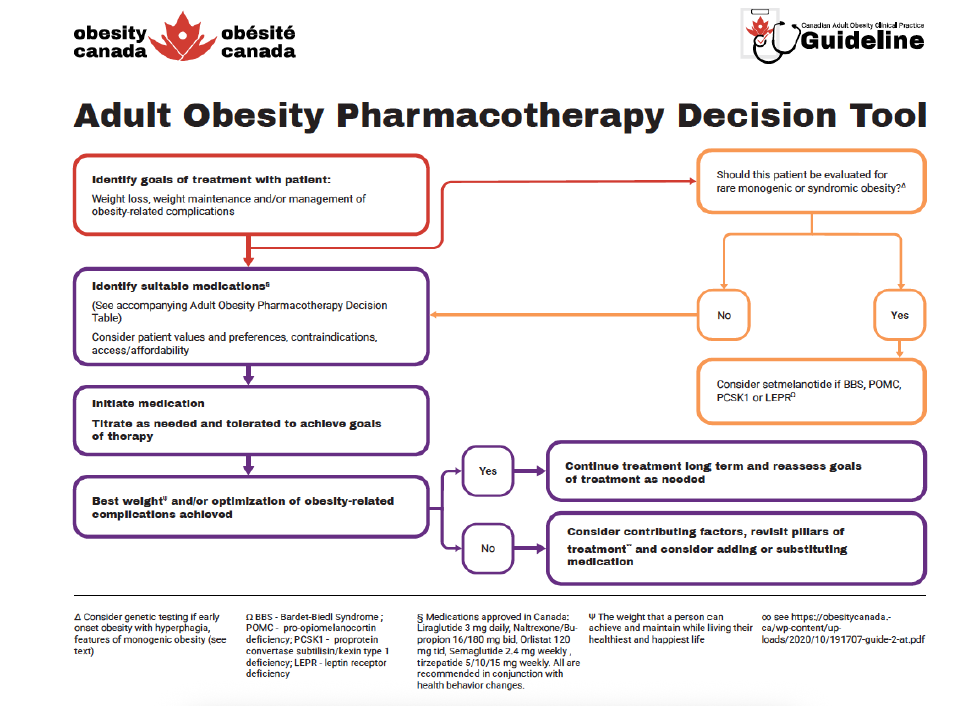
Finally, we have a brand new Decision Tool and Table to help health care professionals in choosing which medication is the most appropriate for each individual patient. We built these tools to be a real time saver in clinical practice!
The Decision Tool is a simple flow chart to guide on the use of medication:
The accompanying Decision Table helps to quickly identify the most suitable individualized medication choice, focused on health benefits that can be achieved with each medication:

For my full overview of our 2025 Pharmacotherapy Clinical Pratice Guideline, watch my video overview here!
Be sure to stay tuned to my blog (subscribe box top right), as I’ll be doing deeper dives into several recommendations and key points from our Guidelines in coming weeks.
ENJOY!
Disclaimer: I volunteered my time and received no remuneration for writing this Guidelines chapter.
Subscribe to my blog! (upper right)
Follow me on X/twitter @drsuepedersen !
Check me out on Insta: drsuepedersen
Share this blog post using your favorite social media link below!
www.drsue.ca © 2025