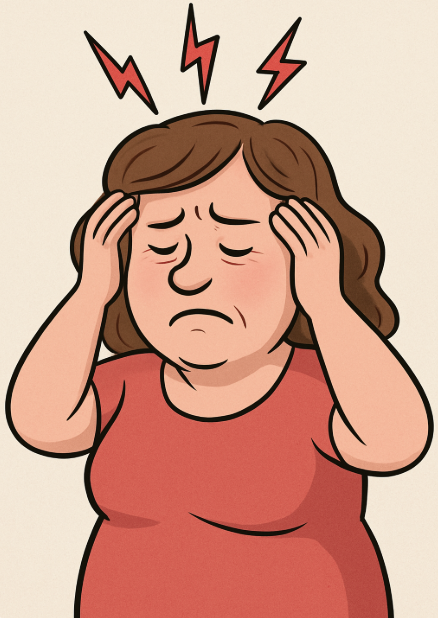
Idiopathic intracranial hypertension (IIH) refers to a condition where pressure inside the skull is increased, without a known cause. Back in the 1900s when I went to medical school, it was called ‘pseudotumor cerebri’, because the findings mimic that of a brain tumor, but there is no tumor to be found. Now, we understand more about IIH – including its very close link with elevated weight. Here are some key points from a recent review of IIH, published in the New England Journal of Medicine.
Why does IIH happen? In simple terms, the theory is that with central obesity, the pressure in the veins draining the head are elevated (elevated jugular venous pressure), which makes it harder for cerebrospinal fluid (CSF, the fluid that cushions the brain) to drain into the venous circulation. (Clinicians: This increased pressure is transmitted to the dural venous sinuses in the brain, reducing the gradient for the normal course of cerebrospinal fluid (CSF) arcoss the cerebral dural sinuses. To maintain the rate of CSF removal, the intracranial pressure becomes elevated, which compresses the dural sinuses, creating a functional stenosis.)
Who is at risk of IIH? Obesity is the driver of IIH in most cases, with risk being higher with higher body mass index (BMI). More than 95% of people with IIH are women of childbearing age with obesity, though it can happen in men and even in children with obesity. Why most people with IIH are reproductive-aged women is unknown. While the estimated prevalence in women with BMI >30 is about 1 in 500, this is likely an underestimate, as the diagnosis is easy to miss.
Symptoms of IIH can include headache (often constant or daily), brief episodes of dimming, blurriness, or loss of vision (visual obscurations), neck or back pain, pulsatile tinnitus (a ringing noise in sync with your pulse), and double vision. These symptoms can mimic other conditions like migraine, and may thus be misdiagnosed. Vision-related alarm symptoms requiring urgent assessment include loss of peripheral vision or reduction in central visual acuity.
The key physical exam finding is papilledema on fundoscopic exam – swelling of the optic disc on the retina (back of the eye). Papilledema may be missed if pupils are not dilated for the examination (which is typically only done at an optometrist or opthalmologist).
Investigations include:
- MRI scan of the brain to rule out other causes of papilledema and increased pressure in the brain, and to look for typical MRI findings of IIH
- lumbar puncture is often done to confirm high pressures (needle into the fluid around the spinal cord, inserted in lower back)
- other potential causes of raised intracranial pressure need to be ruled out. Per the review article, tetracycline-class antibiotics and retinoids (vitamin A and associated compounds) can rarely raise intracranial pressures.
The foundation of treatment of IIH is decreasing the intracranial pressure. This can usually be accomplished with acetazolamide, a carbonic anhydrase inhibitor which reduces cerebrospinal fluid (CSF) production. Weight loss is also foundational to treatment of people with obesity and IIH, as weight loss reduces intracranial pressure. While there aren’t much data, this review specifically recommends GLP1-based therapies to facilitate weight loss in people with IIH. In addition to weight loss, interestingly, animal data suggest that GLP1 agents may reduce intracranial pressure by decreasing CSF secretion. Bariatric surgery has been shown to be effective to decrease intracranial pressures in people with IIH.
Surgical approaches may be needed to decrease pressures in some cases of IIH, particulary if there is compromise of vision. There are a number of surgical approaches including fenestration of the optic nerve sheath, placement of a dural venous sinus stent, and CSF shunting. The goal of these treatments is to prevent vision loss.
BOTTOM LINE: Idiopathic intracranial hypertension (IIH) is closely linked to obesity, most often seen in reproductive aged women with elevated weight. The diagnosis can be missed because symptoms can be confused with other diagnoses (such as migraine), and the finding of papilledema on the eye exam may be missed. It’s important for clinicians, and for people with obesity and any symptoms of IIH, to be aware of and consider this possibility. Treatments are directed at reducing the pressures in the brain, and weight loss.
Share this blog post using your favorite social media link below!
Follow me on twitter! @drsuepedersen
www.drsue.ca © 2026