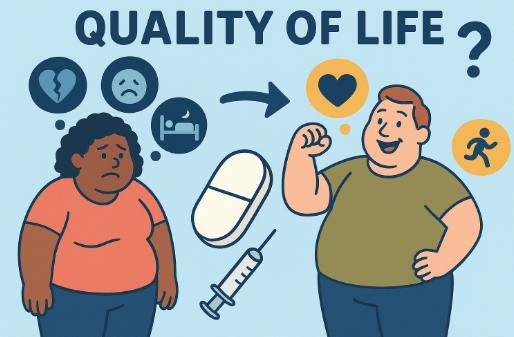
Treatment goals in weight management should naturally include outcomes that are important to the person being treated. Some of the goals that my own patients identify often include things like reducing pain, being able to be more active with their family/friends, or to feel more confident. And almost always, one of the goals I often hear is simply ‘to feel better’.
Intertwined in much of this discussion is the search for a better quality of life with successful weight management. The term ‘quality of life’ (QoL) broadly encompasses how a person measures the ‘goodness’ of multiple aspects of their life. Obesity has a negative impact on many aspects of health-related quality of life, and weight loss is associated with improved quality of life in most studies.
In our 2025 Obesity Canada Clinical Practice Guidelines on Pharmacotherapy for Obesity Management (disclosure: I am the lead author), we specifically searched the literature for evidence on weight loss medications to improve quality of life.
We found that five of the six weight management medications available in Canada have demonstrated improvement in quality of life in clinical trials [liraglutide (Saxenda), naltrexone/bupropion (Contrave), semaglutide (Wegovy), tirzepatide (Zepbound/Mounjaro), and setmelanotide (Imcivree)]. Physical function was also improved with liraglutide, naltrexone/bupropion, semaglutide, and tirzepatide. Studies of orlistat, an older medication that works by reducing dietary fat absorption from the gut, did not assess impact on quality of life or physical function.
It’s important to remember that each individual’s weight management journey is unique. There are so many factors playing in to quality of life, both physical and psychological. While physical function generally improves with weight loss, a person may not feel better if they are, for example, dealing with side effects related to medication. The relationship between mental health and obesity is complex, and while many people’s mental health improves with weight loss, there are other situations where the reverse may occur. A person may feel discouraged if they are not meeting their treatment goals. If a treatment goal is being partially achieved (let’s say the goal you set is increasing your dog walks from 500m to 2km, and you’ve made it to 1.5km), it’s important to celebrate this win and feel positive and empowered by this improvement! Relationships with friends or spouses can change in a positive way, but can also sometimes change in a negative way – loss of connection around food-centered socializing, or jealously around the weight loss success are just a couple of examples.
BOTTOM LINE: Weight management medication is associated with improvement in quality of life in clinical trials. Remember that each person’s journey is unique, and not everyone may experience an improvement in quality of life. If you (or your patient) are not feeling improvement in quality of life, it’s important to explore physical health, possible side effects, and as always in any weight management journey, mental health. And remember to celebrate ANY success towards achieving treatment goals!
Disclaimer: I volunteered my time and received no remuneration for writing this Guidelines chapter. I am/have been an investigator in clinical trials of liraglutide, semaglutide and tirzepatide. I receive honoraria as a continuing medical education speaker and consultant from the maker of liraglutide and semaglutide (Novo Nordisk), naltrexone/bupropion (Bausch), tirzepatide (Eli Lilly), and setmelanotide (Rhythm).
Share this blog post using your favorite social media link below!
Follow me on twitter! @drsuepedersen
www.drsue.ca © 2025