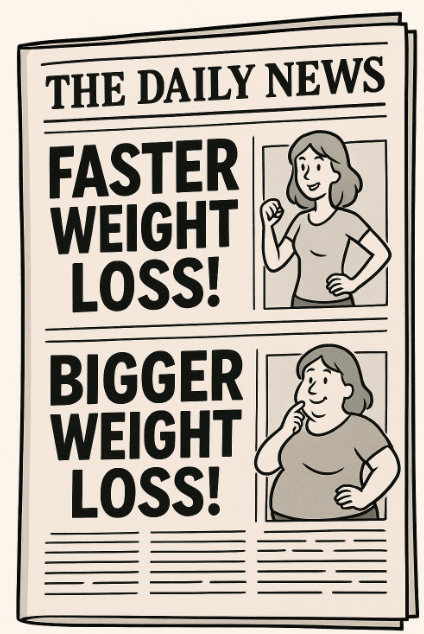
As we advance the field of obesity medicine, headlines around weight loss medication studies become louder and louder in the media. These headlines are written to demand the attention of people living with elevated weight and investors alike, applauding the very biggest and fastest weight loss numbers, and slamming treatment results that aren’t as large or as fast.
An important point I want to call out today is: Greater and faster weight loss is NOT equivalent to better weight loss.
Why isn’t more weight loss always better?
It is true that with greater weight loss, we tend to see greater health benefits. It’s also true that some people say they want whatever medication will give the most possible weight loss. However, with the new and emerging highly effective weight loss medications, in many cases, the maximum dose may provide too much weight loss. We need to adjust treatment in partnership with our patients, as needed, as tolerated, and as appropriate, to achieve treatment goals.
Here’s an example: In the REDEFINE-1 study as blogged previously, CagriSema [(a combination of semaglutide (Wegovy) and cagrilintide (amylin)] was found to provide an average 20.4% weight loss, with over a third of participants achieving 25% weight loss, with expected metabolic health benefits. These are fantastic results – and yet, these results were highlighted as failures in the media, because the weight loss fell a few percent short of what had been predicted. In the REDEFINE trials (disclosure: I am an investigator and senior author of the related REDEFINE-2 trial), we had the freedom and flexibility to adjust the dosage to fit the patient – exactly how we should be treating patients in the real world – and many people didn’t need the full dose of treatment. Had these trials not had that flexibility, this would likely have pushed the weight loss results higher, but likely would have come at the consequence of some people losing excessive weight, and/or more people dropping off of treatment because of too much weight loss. Read more on similar thoughts in this New England Journal of Medicine editorial.
Here’s another example: orforglipron, a novel non-peptide oral (pill) GLP1, has also received a bad rap in lay media. As blogged previously, In the ATTAIN-1 trial, published in the New England Journal of Medicine, 3,127 people with obesity were randomized to receive orforglipron 6mg, 12mg, or 36mg daily, or placebo. At 72 weeks, the weight loss seen was -7.5%, -8.4%, and -11.2% with 6mg, 12mg, and 36mg respectively, vs -2.1% with placebo. Almost one in five patients in the orforglipron 36mg group lost at least 20% of their weight. In ATTAIN-2, a similar study in people with type 2 diabetes and obesity, weight loss was -9.6% with the 36mg dose vs 2.5% with placebo, with an impressive improvement in A1c (diabetes report card) of -1.7% vs 0.5% with placebo. The media responded to these results negatively, comparing these weight loss results to the injectable GLP1 based treatments, which provide more weight loss and a little more A1c reduction in some cases. What is totally being missed here is that a lot of people could benefit from orforglipron treatment, if/when it becomes available. This amount of weight loss is plenty to achieve treatment goals for many people, and again here, more weight loss may not be appropriate nor desired for some people. The A1c reduction may be hitting the point of normalized sugars for some people, and can’t actually get any lower for them. And finally – importantly – it is expected that orforglipron will come into the market at a substantially lower price than the current injectable GLP1 pricing – making it available and affordable to people who otherwise wouldn’t have access to a GLP1-based treatment at all.
Headlines on earlier phase treatments are often written in a spirit of fierce ‘competition’ for which medication can give the most weight loss in just 12-20 weeks’ time – and this concerns me greatly as well. Many people who struggle with elevated weight feel frustrated, and it can seem appealing to consider a medication that promises the ‘fastest possible’ weight loss. The critically important point here is this: Faster weight loss is NOT better weight loss. If a person is eating so little due to appetite suppression from the medication, we are concerned that nutrition may not be adequate. While weight loss of any cause decreases bone density, faster weight loss may result in faster bone loss. Though it is not clear from the literature, muscle mass may deplete faster with faster weight loss as well.
As the financial stakes rise in parallel amongst investors with this media frenzy, the result is a vicious cycle of pharma feeling pressured to satify investors with bigger and faster weight loss results. The real winners in successful long term treatments will be those who follow the principles of individualizing and adjusting treatment as needed, as tolerated, and as appropriate to each person, at a price point that makes these important treatments more accessible.
Disclaimer: I am/have been an investigator in clinical trials of CagriSema and orforglipron. I receive honoraria as a continuing medical education speaker and consultant from the makers of CagriSema (Novo Nordisk) and orforglipron (Eli Lilly).
Share this blog post using your favorite social media link below!
Follow me on X/twitter! @drsuepedersen
www.drsue.ca © 2025